Monday, November 24, 2014
Teaching Different Styles of Learners
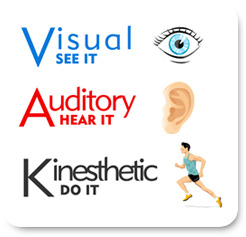
Different learning styles create different opportunities for learning success. If we accommodate for different learning styles, we not only increase engagement with learners, but we also increase the amount of variety in our lessons. Here are some great links to resources on different activities for different styles of learning:

Saturday, November 22, 2014
7 Teaching Ideas
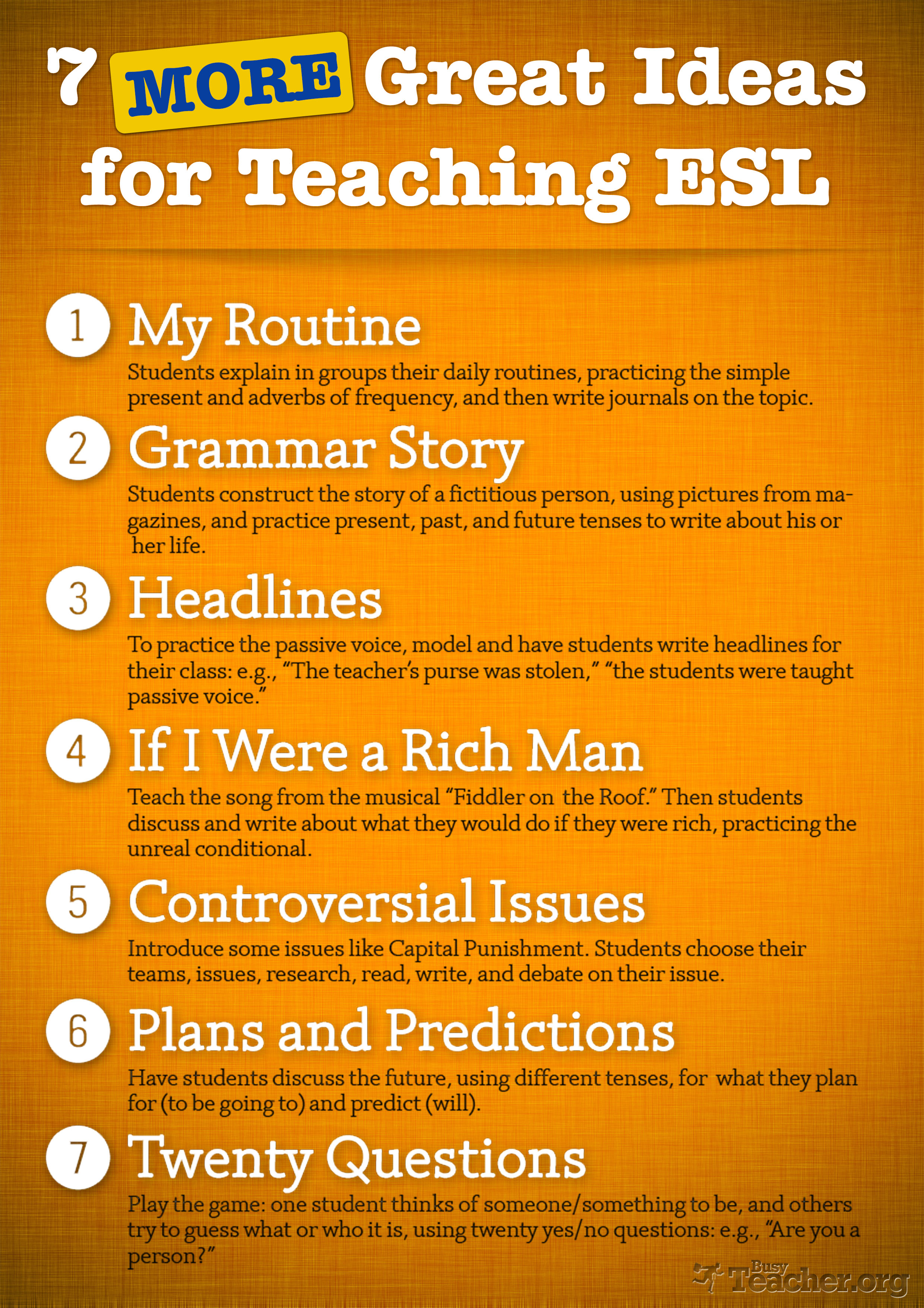
BusyTeacher.org has some great lists of different teaching activities and ideas. These are easy, creative, and require little preparation.
Link HERE
Link HERE
Monday, November 17, 2014

Friday, June 20, 2014
Listen to the News
News & Headlines Listening Tasks
News can be a great way to bring authentic listening into the classroom. Some great places to find News to use in the classroom are:
VOA - Voice of America
BBC - BBC Learning English
BBC - News Headlines
Krashen’s (1981) theory of
Comprehensible Input offers that for language learning to occur, sufficient
input (at a level that can be understood) must be received by the learner. Nation & Newton (2009) extend this idea
specifically to listening via his approaches for Meaning-Focused
Listening. The acronym “MINUS” can be
used to test the conditions for meaningful listening.
M – Meaningful: Is the input a piece of meaningful communication?
I – Interesting: Does the input contain
information that will prove interesting
to the learner?
N – New Items: What learnable language,
ideas, skills or text types (LIST) will learners meet through the listening
experience?
U – Understanding: Can the
learners understand the input? How is understanding assisted (e.g. controlling
the level of difficulty, scaffolded learning)?
S – Stress-free: How is stress and anxiety
controlled?
Nation & Newton (2009)
Two methods of in-class listening are proposed
below. These methods meet MINUS
requirements.
KWL (Know /
Want to Know / Learned)
KWL is a reading (input)
comprehension established by Ogle (1986) that seeks to aid understanding. Firstly, prior knowledge is activated. Then, students highlight set goals for
comprehension (identifying what they would like to know more about). Finally, students identify what they have
learned.
Find the File HERE
Information
Transfer – News Grid
Information Transfer (IT)
tasks have been identified (Palmer, 1982) as an effective method for gauging
comprehension as they force learners to change the form of the input they hear
(or read). A second advantage of IT
tasks is that they can be much easier to create than sets of comprehension
questions.
Find the File HERE
Krashen, S. (1981). Second Language Acquisition and Second Language
Learning. Oxford: Pergamon Press.
Ogle, D.M. (1986). "K-W-L: A teaching model that develops
active reading of expository text." Reading Teacher, 39, 564-570. K-W-L
Reading Method.
Nation, I.S.P.
and Newton, J. (2009) Teaching ESL/EFL Listening and
Speaking. New York: Routledge. 205 pages. ISBN 978-0-415-98970-1
Palmer, D. M.
(1982). Information Transfer for Listening and Reading. English Teaching Forum 20, (1), 29–33.
Wednesday, April 23, 2014
The Big Board
In any language class, the presentation stage of a lesson is key to effectively illustrating to learners important language features. There are many ways to do this:
But my personal favorite is the trusty (and dusty) blackboard.
However, for something that is often the focal point of a lesson, we can sometimes find ourselves not giving sufficient planning to it. What follows is a few key guidelines I use for developing my boards:
Here is a sample board I used for a recent lesson on the present perfect.

Now, once the board is set for class, we can use it for the presentation stage of our lesson. However, simply ending there and erasing might be a waste. I like to have my learners interact with the board and add either examples of the target language or what what they perceive to be relevant information. In this way, learners engage with the board and become involved in the presentation stage of the lesson.

- PowerPoint
- Graphics
But my personal favorite is the trusty (and dusty) blackboard.
However, for something that is often the focal point of a lesson, we can sometimes find ourselves not giving sufficient planning to it. What follows is a few key guidelines I use for developing my boards:
- N - Neat: Make sure your board is not overly cluttered
- I - Informative: The board should hold the relevant information
- C - Color: Effective use of color can clarify and interest
- E - Easy to Understand: Learners should be able to quickly comprehend the board
Here is a sample board I used for a recent lesson on the present perfect.
Now, once the board is set for class, we can use it for the presentation stage of our lesson. However, simply ending there and erasing might be a waste. I like to have my learners interact with the board and add either examples of the target language or what what they perceive to be relevant information. In this way, learners engage with the board and become involved in the presentation stage of the lesson.
Saturday, September 28, 2013
Songs for Grammar
I've always been a fan of using either songs or movie clips so show language in context. If you can use clips that relate to your learners' own lives (e.g. movies or songs suggested by them) then it adds even further interest and motivation to the learning of language/grammar.
However, one of the big obstacles with using songs is of course the difficulty in actually 'hearing' the lyrics. We've all heard those songs in which we mishear lyrics - Hendrix: "Kiss this guy"...
Therefore, lyric videos are a great way to overcome this as they display lyrics within the video. If you search Youtube for "official Lyric Video" you can find some amazingly produced example of lyric videos.
Anyhow, here are some great examples I've found and the grammar/language they could be used to highlight:
The Summer Set, Boomerang - Second Conditionals
Tegan & Sara, I was a Fool - Simple past
P!nk, Just Give me a Reason - Present Perfect / Present Perfect Progressive
Taylor Swift, We Are Never Ever Getting Back Together - Past tenses, Present Progressive
I've used such videos to do the following:
Focus on Changing Tenses - for example, in the song "We Never Ever Getting Back Together", have students focus on why the tenses change (i.e. showing how past actions can affect present states)
How many? - Have students spot incidences of target language (i.e. how many times are 2nd Conditionals used in "Boomerang"?)
Larry Ferlazzo's great blog also had a post on Lyric Videos
The Summer Set, Boomerang - Second Conditionals
Tegan & Sara, I was a Fool - Simple past
P!nk, Just Give me a Reason - Present Perfect / Present Perfect Progressive
Taylor Swift, We Are Never Ever Getting Back Together - Past tenses, Present Progressive
I've used such videos to do the following:
Focus on Changing Tenses - for example, in the song "We Never Ever Getting Back Together", have students focus on why the tenses change (i.e. showing how past actions can affect present states)
How many? - Have students spot incidences of target language (i.e. how many times are 2nd Conditionals used in "Boomerang"?)
Larry Ferlazzo's great blog also had a post on Lyric Videos
Subscribe to:
Posts (Atom)
